


By SCOTT AUST / Greater Garden City
On Monday, the Board of Finney County Commissioners approved the Special Use Permit application form for Data Centers that addresses the information those types of projects will need to provide before a permit is issued.
No specific data center project has applied for a permit yet. The application form is intended to address the unique characteristics associated with data centers, including site design, utility and infrastructure demands, environmental considerations, public safety, emergency response planning, traffic impacts, noise, lighting, water use, and decommissioning.
Commissioner Gerry Schultz said staff did a wonderful job addressing the criteria that will be reviewed.
“I think it’s important for everyone in Finney County to know that we’re open for business, and that means that we’re going to carefully review these applications, being mindful of everyone’s input,” he said.
Several residents concerned about data centers aired a variety of concerns about such projects including a perceived lack of transparency, concerns about farmland, migratory birds, emergency fire response in the case of battery storage facilities, water use, soil erosion, noise during construction, decommissioning, electrical grid impacts, and non-disclosure agreements. Some urged slowing the process down and holding meetings in the evening when most people are off work.
Schultz said the Board is intent on addressing in the application those concerns raised publicly and other concerns that the public may not have yet considered, such as roads, facilities and infrastructure.
“This permit application that we are adopting today … provides us as the final say on the permit application, to provide all the safeguards that our community needs to be successful, to keep in mind the uses that are allowed, and it also allows us to provide the opportunity for public input when the time comes,” he said.
Commissioner Kevin Bascue added that the public would benefit by going to the county’s website and reviewing the agenda packet which includes all the different types of information that will be requested of any data center applicant.
“At this time, nobody has applied for this permit,” Bascue said. “Until such time as somebody fills this out, then we have an opportunity to examine that document and make sure that all of your issues are addressed, all of our issues are addressed, and we can make an informed decision at that time.”
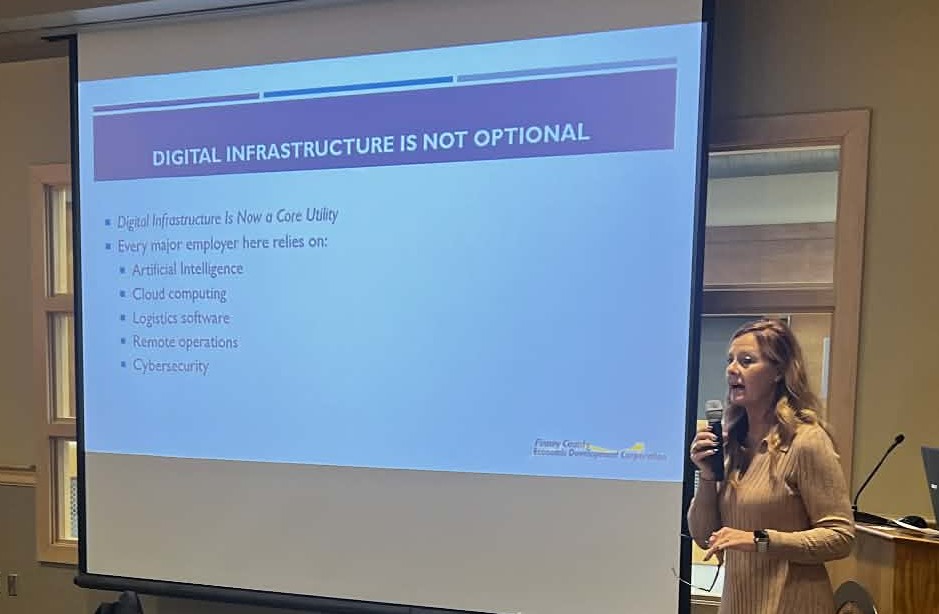
Lona DuVall, President & CEO of Finney County Economic Development, said it’s important for Finney County to set standards and be proactive on data center projects given the federal stance on the issue. The Trump Administration has been clear these projects are going to happen.
“That national landscape is already moving, and it really is a national priority. They have streamlined regulations, they have ensured that they’re going to speed processes up,” she said. “We felt we had to have a process locally, because it’s very possible that if we don’t have our own process, these could still be placed in our community. We just wouldn’t get the opportunity to shape them. We would have just been told where they were going.”
Data Centers are not just for Artificial Intelligence or creating TikTok videos. DuVall said they are also important for national security and economic competitiveness that impacts a variety of industries including hospitals, banks, supply chains, and even agriculture.
All of those things are utilizing cloud computing, which is part of what these data centers, these digital infrastructure campuses are doing.
“That stuff’s happening already in artificial intelligence. We aren’t going to change the trajectory by making a decision in one state or one county or one community that we’re not going to participate,” she said. “The only thing we’re doing by choosing not to participate is potentially costing ourselves the opportunity to shape the decisions that get made and instead just have to live with the decisions that get made somewhere else.”
Schultz said many communities in Kansas have had a reactionary response to renewable energy, data centers, and battery storage. Finney County planned ahead by creating regulations and the application process for special use permits.
“Nobody’s going to build anything until they have a community benefit agreement that’s suitable to the five of us. There’s a lot in that application that they have a lot of responsibilities to do, and we will see that they do it if we choose to approve their application,” Schultz said.
Schultz added the commission is not going to prejudge a project. The Board will make sure the process is fair and has been well thought out.
DuVall said the accusation by some data center opponents that these projects are being kept secret just isn’t accurate. She said FCEDC first learned of data center interest in the county in November, not four years ago as one speaker claimed. It’s possible those companies have been talking to landowners that long, but FCEDC was not a party to it.
Regarding non-disclosure agreements, DuVall said sometimes NDAs are entered into during the preliminary phase of a project when it is necessary for preliminary information to protect a company’s interests before they are ready to be made public.
“Again, that’s not trying to hide anything. That’s just protecting project specific information, until they know that they’re going to go forward with it. Once it becomes a public process, once they’ve applied for a permit, whatever the case may be, those NDAs no longer bind us,” she said.
DuVall pointed out that public discussion of renewable energy and digital infrastructure trends was the main focus of the FCEDC annual meeting in January and The Garden City Telegram (January 26, 2026) and the Greater Garden City website (https://greatergardencity.org/2026/01/energy-and-digital-infrastructure-becoming-driving-force-for-u-s-finney-county-economies/) both wrote stories about it.
“That entire meeting was focused on these energy projects and the potential for data centers, a discussion about artificial intelligence and machine learning,” she said. “Since that time, we’ve taken a ton of phone calls in the office. We have a lot of people who come by and visit the office, just wanting more information. I’ve been asked to present at coffee clubs and social groups and civic organizations. I’m always happy to do that”
DuVall said she welcomes questions and helping the public understand the facts.
When it comes to water, DuVall said the question is not whether a project uses zero water. It should be does the project use less water than is currently being used in the project area.
Based on 2023 publicly available numbers, 10,000 acre feet of water is being pumped annually in the project area for agricultural uses. Put it another way, that amounts to 3.26 billion gallons of water per year.
Until there’s a final project design, a project can’t provide a perfect answer on water use but it will likely be significantly less than current use.
“A lot of the rhetoric would have you basically compare this to no water use, right? But zero water use is not the current condition out there. The current condition out there is irrigation. It is large scale, agricultural water withdrawal from the aquifer,” DuVall said.
DuVall said the permit application provides the framework that provides the opportunity to ask more questions and gather more information about more design specifics related to these projects.
On another concern, DuVall said tax abatements are a state policy not a local one. However, it does create an opportunity locally to negotiate payments in lieu of taxes, contribution agreements or donation agreements to hold projects accountable for local impacts on infrastructure. Conversations are ongoing between local taxing entities about how to address those growth-related needs in advance of data center projects.
“We’re going to continue to have those conversations, because if we can’t do this right, if we can’t plan accordingly, then we shouldn’t do these projects,” she said. “We’re not going to encourage you to do them unless we know we have a plan in place to deal with the projects and the growth that can come with them.”
No one is talking about ending agriculture or farming heritage in Finney County, Duvall said.
“Far from it. We’re actually looking at the possibility that by taking a small percentage of the current land used for agriculture and repurposing it, it creates a chance that that actually improves the farming future for the rest of the farmable acres in Finney County. We’re going to continue to weigh that,” she said.
Along those lines, DuVall said it’s important to remember that the project area is privately owned property. For those landowners, it isn’t just a business decision. For them, it’s a family question, a legacy question, a question tied to generations of memories, identity, and pride.
“It’s hard to look at land that has helped define your family’s history and ask whether the future of that land needs to look different. It’s hard to weigh sentiment against science. It’s hard to weigh tradition against the math of a shrinking aquifer. It’s hard to weigh the expectations of others against the responsibility you owe your own family. But that’s the kind of hard decisions they’re being asked to make,” DuVall said.
DuVall care should be taken before letting those who don’t own the land, carry the responsibility, or shoulder that burden dictate what a landowner can do with his or her property. At the least, a process should be created to look at the opportunities being presented.
“We’re not asking people to blindly accept any of this information. Right now, the only decision you’ve made is that you’re willing to look,” DuVall told commissioners. “And this community should be very thankful to you. I can assure you, the landowners are very thankful to you for at least giving us the opportunity to look at what something different could mean for our community.”
DuVall said she is always available to answer questions. Nobody should feel they’re getting something shoved down their throat, but there will be hard choices to make and they should be made with all the information in hand, “not just based on some meme shared on Facebook.”