



By SCOTT AUST / Greater Garden City
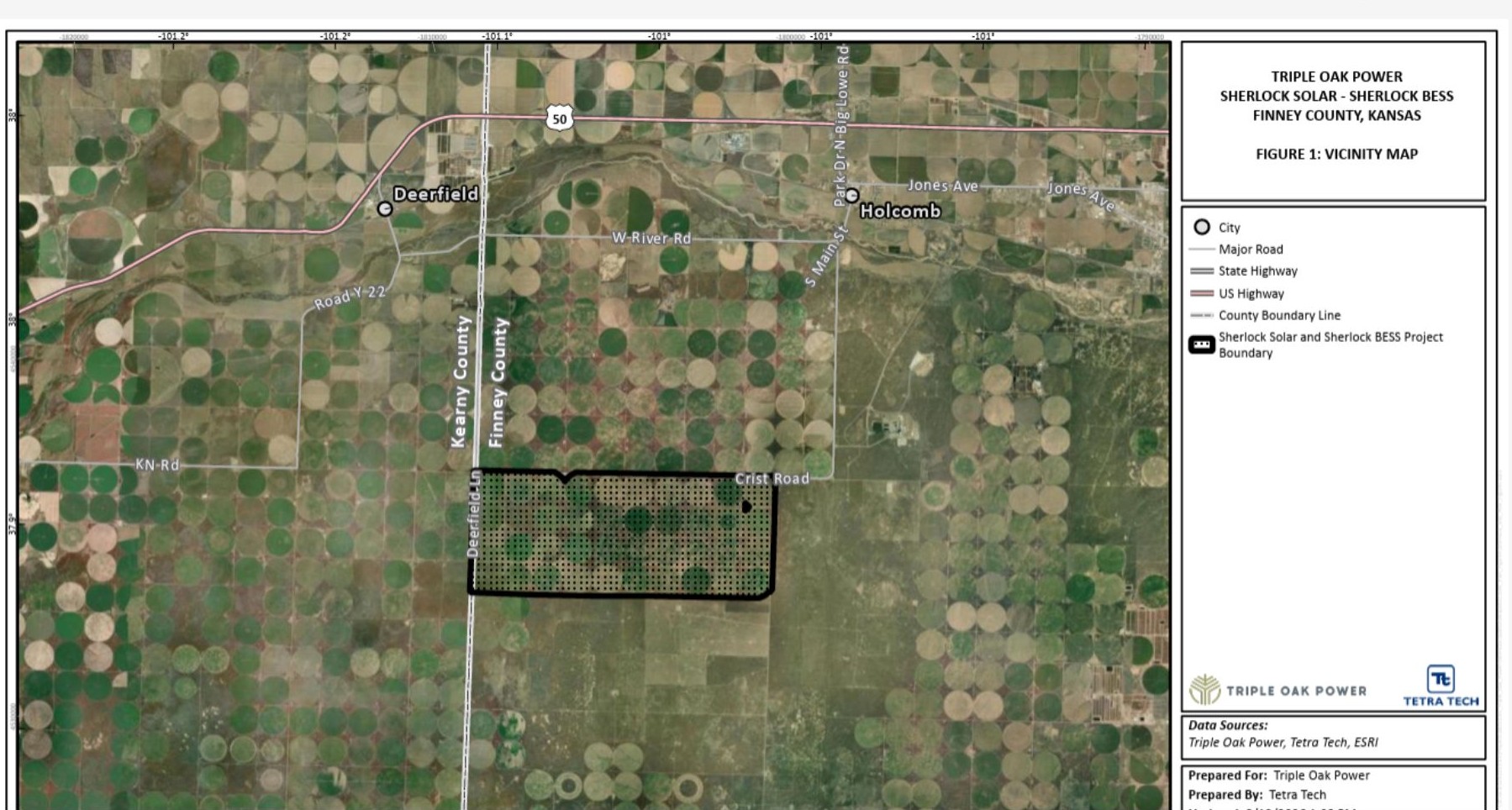
The Finney County Commission on Monday approved special use permits for two renewable energy projects on land generally located south and west of the Holcomb power station.
Triple Oak Power plans to build a 400 MW solar project (Sherlock Solar) within the 6,150-acre site, and a Battery Energy Storage System (BESS) on 54 acres within the site that will interconnect with the Sunflower Electric transmission system and will have the capability to both charge from and discharge energy to the bulk electric grid
The Solar and BESS projects are part of a larger initiative, the Home Range Clean Power Project, proposed to occupy portions of Finney, Wichita, and Kearney Counties. In addition to Solar and BESS projects, the Home Range project plans also include Digital Infrastructure Campus (DIC), Wind generation, Natural Gas generation, substation, switchyard and transmission line development. The remaining components will file separate SUP applications.
Home Range is Triple Oak’s multi-project activity in southwest Kansas. The Home Range projects represent an enormous economic investment in Finney County, creating hundreds of new jobs and providing substantial new revenue to the county and community.
Triple Oak was founded a little over five years ago. Its mission is to develop sustainable energy plants. Jesse Gronner, Triple Oak CEO & Co-Founder, has been involved in power generation development for more than 25 years and believes it’s important to do things the right way.
“To me, sustainability is not just an environmental term, it’s about economic stability for community, it’s about a legacy for agricultural properties to survive in the ups and downs that come from farming, so a lot goes into the word sustainability,” Gronner said.
Triple Oak anticipates beginning construction in Spring 2027 with a two-year build period to be operational in the second half of 2029.
The commission voted 4-0 to approve the applications. Commission Larry Jones recused himself and did not participate in the discussion due to a potential conflict of interest.
Commissioner Gerry Schultz said it’s important for the public to understand that approving the SUP gives Triple Oak the opportunity to prepare several additional agreements that are required before the county would consider issuing a building permit. Those requirements, spelled out in the SUP, checked all the boxes for Schultz, who said there are three primary things that are carefully considered on any large project.
“First, are we making a benefit to the community and to the industry we have and adding to its diversity and strength? We’ve seen that. Two, is government making the required things to be done in an open and fair way so that the landowners receive the benefit of their land, that capitalism works in our community, and that we have the potential to have economic growth, tax revenue, and be able to have the opportunity in the future to hold the line on the rate taxes are assed and made? Third, and most importantly, have we as a government required the company to be a good steward of this land, that they know how they’re going to come in and use it, how they’re going to pay for the cost of using it, and at the end are they going to clean up after themselves and restore this ground,” Schultz said.
Required plans and agreements that Triple Oak will need to prepare include a development agreement; official site and building plans; road use and maintenance agreement; community benefit agreement; vegetation management and land stewardship plan; stormwater and erosion plans; emergency readiness plans; a sound study; a glare report; and a decommissioning agreement.
Gronner said the company welcomes transparency and agreed it has many obligations to meet as it further refines the designs with more specificity.
“There’s a lot more detail that goes into that and we look forward to working with the county and staff to make sure we meet all those requirements,” Gronner said. “Another thing to point out is we are not intending to turn dirt tomorrow after this permit application. We have a lot of work that follows here, a lot of details that will lead up to, at the earliest, late spring of next year when physical construction could begin.”
Gronner said he appreciated the feedback regarding soil and vegetation in the Sand Hills and said Triple Oak has a vested interest in making sure blowing sands and dust don’t impact the solar generation. There’s both a business and commercial need to address the issue.
“More importantly, we need to make sure our neighbors and the general area are not facing some new significant impact of blowing dust that wasn’t there before,” Gronner said. “These are the type of things where the more we know about hyper local concerns, the more we can address them early and thankfully we’re early enough in the process to be able to tackle the issue head on.”
Vegetation for the project will reflect the local climatic and soil conditions, seed mix or target plant community composition designed to thrive with little to no irrigation and routine landscape maintenance practices, according to the SUP.
Commissioner Kevin Bascue said he recently viewed the vegetation around a solar array near Dodge and felt it did a good job addressing blowing dirt which has him hopeful about efforts here. Bascue also asked Gronner about water use on the Finney County property and said his understanding is there may be actual water savings by changing from the higher water use pivot irrigation on ag land to this other use.
Gronner said Triple Oak worked with property owners within the site boundaries to acquire water rights, both surface and irrigated, and there will be a net benefit in water savings. However, Triple Oak is being careful not to drop specific numbers until a specific location for the solar panels is chosen within the project boundaries.
“I’m comfortable referring to that net benefit but right now we want to make sure our calculations are accurate,” he said. “We are definitely taking water as a serious concern. People want to know numbers, and I can commit that we will provide numbers as soon as we have them.”
According to the SUP application, the solar and BESS projects will use a limited amount of water in the operations and maintenance building and water will be required for emergency response needs. The source of water will be determined prior to building permit submittal.
Commissioner Mike Utz asked if Triple Oak’s projects are contingent upon having a data center built nearby.
Gronner said Triple Oak initially planned to build just a wind farm, but market forces have driven a demand for energy from data centers and other advanced loads. Triple Oak sees the increased demand as an opportunity to enhance “all of the above” types of power generation, to include wind, solar, natural gas and access to electrical infrastructure.
“We see this right smack dab in the middle of the United States and I’m genuinely excited about what we can do in Finney County and surrounding areas. It can be big, and it can be substantial,” he said.
To the heart of the question, Gronner said, Triple Oak would not be able to develop to the scale it has contemplated for the full suite of Home Range Clean Power without an increase in load scale, whether that’s a data center or some other type of manufacturing plant that uses a lot of electricity.
“For us as power plant developers, we’re really seeing the opportunity to co-locate our load with our power plant. We’re not constrained by transmission lines. And it’s much more symbiotic as to how you produce and consume,” he said.
Right now, both in the United States and the global marketplace, data centers are the demand, he said.
“Data centers are looking at locations such as this where they can have certainty of power, they can have quality of power, they can have relatively clean elements for that power, and they can find communities that really are open for business. I think that’s why we’re excited about proposing what we’re doing here,” Gronner said.
According to the SUP application, the solar and BESS projects are not expected to cause significant adverse impacts on community facilities, the transportation network, or area utilities. The project will interconnect with the regional transmission system and is expected to provide reliable, flexible capacity and ancillary services that support the stability of the Sunflower Electric Power Corporation system.
By strengthening regional power supply and supporting a more balanced energy mix, the project is expected to contribute to long-term grid reliability and help manage electricity costs.
The project will generate new property tax revenue and other local economic benefits that support community facilities including schools, roads, and emergency services. A preliminary economic benefit analysis has been done but Triple Oak will commission a comprehensive economic impact analysis for each component of the Home Range Clean Power Project performed by a third party.