



By SCOTT AUST / Greater Garden City
Editor’s Note: The full video recording of the presentation from which this story is based is available on YouTube.com. Search for Finney County Economic Development Corporation Meetings and then click on the April 29, 2026, meeting. The presentation begins at the 1:09 mark of the video.
The prospect of data center and renewable energy projects potentially building in Finney County has generated much discussion in the community lately.
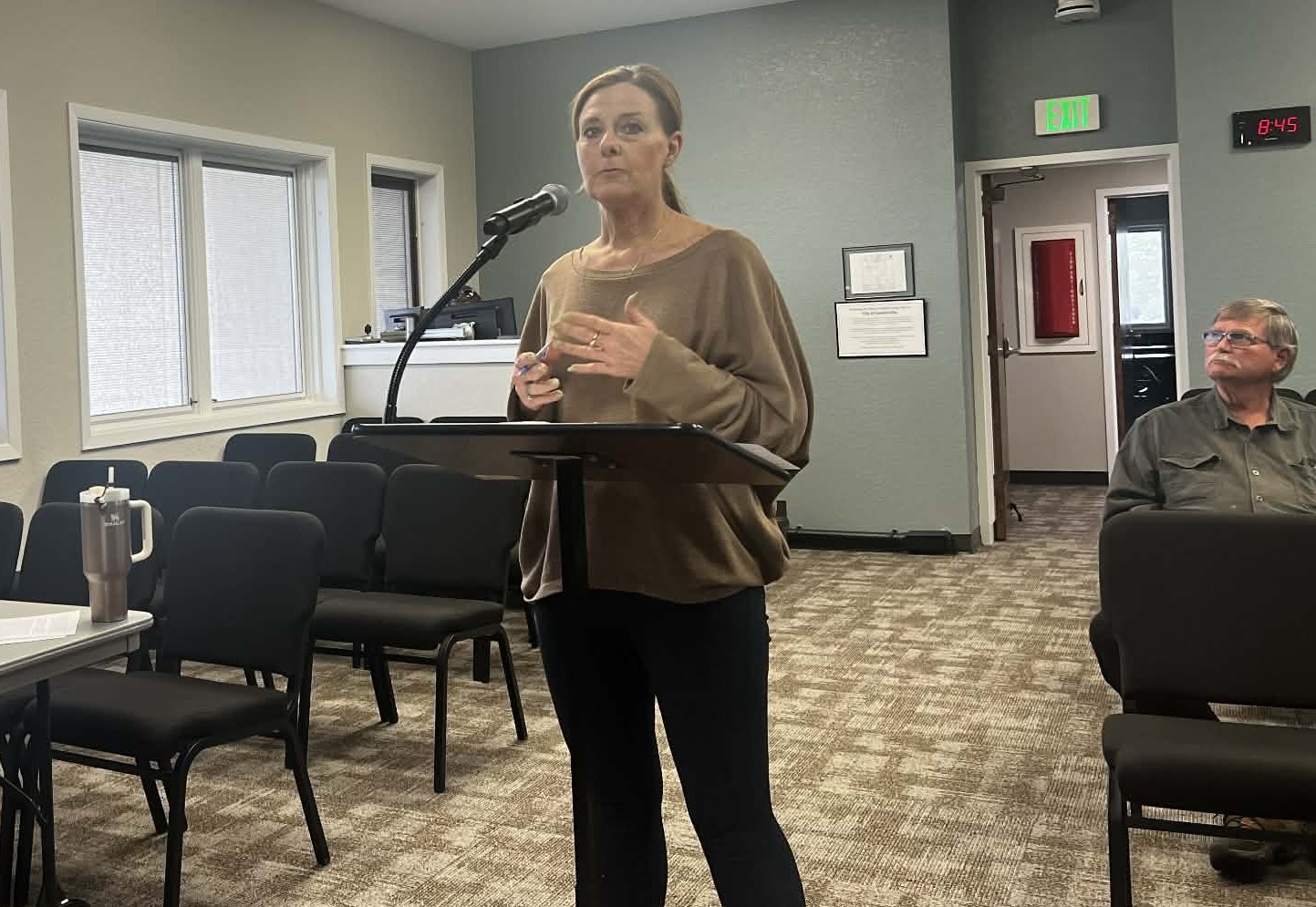
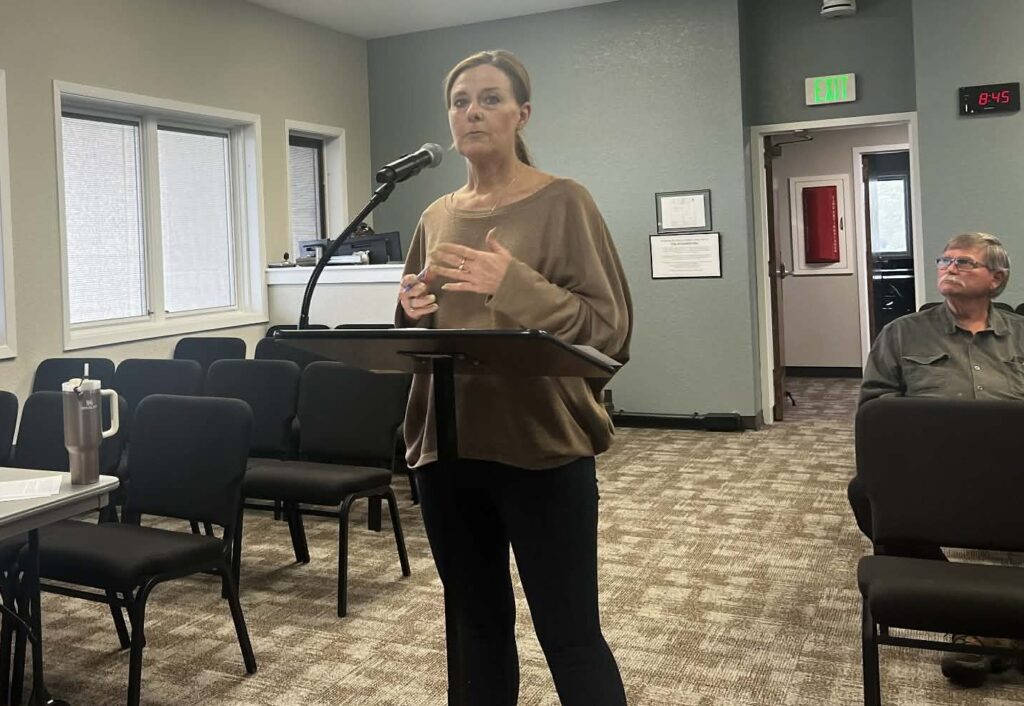
On Wednesday, Finney County Economic Development Corporation President and CEO Lona DuVall presented information to the FCEDC Board of Directors about why FCEDC chose to investigate the potential of those types of facilities, not to be a cheerleader for the projects but to gather facts and be prepared for the possibility.
The presentation emphasized the need for a transparent process in evaluating new digital infrastructure projects, including data centers and energy systems. Key points addressed water, potential economic benefits, and the necessity of local control. It also highlighted the impact of federal and state policies on AI and data centers, challenges faced by agriculture, and the pitfalls of engaging in social media debate.
“I think it’s really important to note that we are not speaking on behalf of projects and we’re not speaking on behalf of specific technology. This presentation is going to talk about the process that we’ve gone through to get to where we are today and where we are with a process that the county and our local communities can utilize, our governing bodies can utilize, to move forward.”
FCEDC is open to a full accountable review of digital infrastructure, data centers, and energy systems should they decide to build here, she said.
“We are here to insist on a process that allows us to analyze the facts and the data related to the new digital age,” she said.
First of all, these projects are not a “done deal.” No construction or operation has been approved, and no final design for any project has been submitted.
“We haven’t seen any final designs for any of these projects that we’re hearing about. They are in the preliminary stage. The special use permit application process was created specifically to allow for more review and more public interaction with these projects,” she said.
Finney County approved an application process for Special Use Permits on April 20. The SUP application creates a framework for applicants to submit details of their plans for public review and accountability.
DuVall said the process allows governing bodies to engage in facts, not rumors. She said decisions should be based on evidence, not social media certainty.
Process and Accountability
Where we are now: only the process is in place. [LD1] The County has created the pathway for applicants to bring forward designs, data and commitments.
- SUP framework. Land use review process, not a construction permit.
- Application burden. Applicants must supply details on water, power, roads, safety, site design and impacts, etc.
- Public review. Planning Commission and Governing Body review, public comment and conditions.
- Development Agreement. Negotiated commitments, including but not limited to Contribution Agreements, road use, restoration, tax impacts and accountability.
- Permits before build. No construction or operation until requirements are satisfied.
What critics call a “done deal” is actually a process for forcing disclosure, analysis and accountability.
“All it says is, if you meet the requirements that we’ve set forth in this zoned area, this is an appropriate use,” DuVall said. “Having that permit in place is the only way we get to the next step. These projects are not going to share their specific designs with us until they know there’s at least a chance they could locate here as long as they meet the requirements we put in place.
Why FCEDC is open to considering DIC + IES projects
A disciplined evaluation began because the potential upside and avoided-risk issues were too large to ignore.
Water: FCEDC is well versed in our water situation. Analysis shows these potential uses may reduce irrigation withdrawals by billions of gallons per year versus current land use.
Tax Base: FCEDC’s prime directive is to grow the tax base, improve the economic climate in the region, and to ensure the dollars necessary to support and sustain growth. Industrial valuation may help protect schools, county services and long-term property values.
Energy Transition: Potential to extend or replace value tied to Holcomb Station footprint.
Property Rights: Private landowners deserve a process that allows lawful alternatives to be fully analyzed.
Jobs: Project discussions indicate 700+ permanent jobs are possible, plus major construction-period activity.
Federal Reality: AI infrastructure is being treated nationally as an economic and security priority.
Current Use: AGRICULTURE
DuVall shared news headlines indicating farmers and producers are experiencing growing anxiety and angst about the future due to rising bankruptcies; crop insurance premium subsidies and drought. For landowners, land-use change is not just an economic question, it is a family, legacy and water-reality question. Landowners are dealing with heritage issues of generations of farming, identity, memory and sacrifice while facing realities of declining water supply, productive capacity and a responsibility to future generations. They deserve a fair process that respects the property owner’s right to consider lawful, regulated, lower-water alternatives.
Water
DuVall pointed out that water belongs to the State of Kansas. The state issues a water right which is tied to specific uses of water and can be modified as necessary.
Water was the primary reason FCEDC could not look away from further analysis of these projects. That analysis compared current irrigation with potential future IES/DIC water use.
Land south of the Holcomb power plant has been identified as a potential project site. Currently, those irrigated acres are using an estimated 3.26 billion gallons (10,000 acre-feet) of water per year.
(Note: An acre foot of water is the amount needed to cover one acre of land to a depth of one foot. That’s hard to picture so gallons make the scale tangible. 1 acre foot = 325,851 gallons.)
DuVall said initial estimates indicate a possible future IES/DIC could use less than half that much water annually but she strongly stressed that a firm estimate has not been prepared yet.
“The estimates they gave us are less, maybe even half of half. We didn’t want to get too excited about that but even at half, even at 1.6 billion gallons of water per year, are we going to consider that? Yeah, we’re going to consider that. That’s pretty significant,” DuVall said, because it’s still a net water savings compared to current irrigated use.
When critics compare future water use to zero, they omit the actual baseline: current irrigation.
FCEDC is well aware of concerns about the Ogalala Aquifer. In 2010, Kansas Geological Survey modeling indicated a need to reduce irrigation in the GMD3 (Groundwater Management District 3) area by 71% to stabilize the aquifer. In 2022, the new model recommended reducing irrigation by 27% in GMD3 to stabilize the aquifer. The reductions in use hoped to save 146 billion gallons per year.
Transitioning some land does not end agriculture in Finney County. Even large-seeming acreage transitions represent a small share of the County’s farmable land base, DuVall said. According to the USDA, Finney County has 821,433 farmable acres. 10,000 acres represents 1.2% of the County’s total farmable acres.
“There’s more to this story than just the number of acres,” she said. “We also have to think about the water, the economic value and the long-term stewardship of those acres. We can’t just stop farming this land and hope for the best in these areas.”
Modern Data Center cooling is not one-size-fits-all
Major operators have publicly described site-specific, lower-water design pathways.
- Microsoft: newer high-density designs can use closed-loop liquid-to-chip cooling with no additional water after initial fill.
- Google: cooling technology selection should consider local hydrology, water risk, energy and emissions tradeoffs.
- Meta: data centers are designed with increasingly water-efficient features and water restoration commitments.
For Finney County, the question is not whether older facilities used more water. It is what design standards we require now.
Proof-of-possibility
Hyperscale operators are already changing water practice. The following examples, taken from those entities’ sustainability and water materials, do not guarantee a local result; they prove that low-water design and stewardship tools are real.
- Microsoft: Water positive by 2030; newest designs optimized for high-density GPU workloads and zero water for cooling.
- Google: Water Risk Framework evaluates local hydrology, water risk, energy and emissions when choosing cooling technology.
- Meta: Since 2012 tracks WUE; 2024 restoration projects generated 1.589 billion gallons of volumetric water benefit.
- Amazon/AWS: Investing in breakthrough data center innovations in power systems, cooling technology and hardware architecture.
DuVall said Finney County’s process requires site-specific proof of how much water is offset from current use to new use. Projects will be held accountable to that. We are not relying on old assumptions of facilities built 20 years ago or even five years ago, or unfounded or unsubstantiated claims.
Special Use Permit process
The SUP (Special Use Permit) application requires the right questions up front. The adopted application asks applicants to bring the information needed for analysis. The SUP is not the end of review; it is the front door to project-specific disclosure.
The SUP requires applicants to:
- Identify what infrastructure is included or excluded from the application
- Explain power source: co-located generation vs. open grid and provide service availability if grid-connected
- Provide water, power and other resource-usage information
- Provide a cooling-system description and water-use analysis
- Disclose sound, lighting, fencing, fire safety, engineering and decommissioning plans
Development Agreements
The heavy accountability work happens after the SUP. The Development Agreement is where commitments can become enforceable. The following is a partial list of things to include in a Development Agreement.
- Water and cooling: final design, water-use analysis, provider agreements, efficiency commitments
- Prairie restoration: native vegetation, dust/weed control, stormwater and decommissioning terms
- Jobs and investment: employment numbers, capital investment, local workforce, and training commitments
- Roads and construction: road-use agreements, access routes, maintenance and restoration obligations
- Community benefit: PILOTs, Contribution Agreements, shared revenue solutions and long-term tax impacts
- Research engagement: willingness to support the Research & Innovation Campus and local applied research
Among other requirements, the SUP asks “can this use be considered here?” The Development Agreement asks “what must be true before it can proceed.”
Land Transition
A land transition can be a stewardship strategy. The goal is not to “take land out of agriculture” and walk away. It is to structure a responsible transition.
- Reestablish deep-rooted native vegetation
- Reduce erosion, dust and noxious weeds
- Improve soil stability and stormwater management
- Restore native prairie ecosystem including wildlife habitats
- Create enforceable restoration and decommissioning obligations
- Use outside capital to support work the region already needs
Holcomb Station
Another strategic concern is what comes after Holcomb Station. FCEDC has long worried about tax base, jobs, energy production and property values if the plant reaches end of life. (It is currently 43 years old. Coal plants typically have a 50-year life span.)
IES/DIC investments may encourage additional investment in and around the facility and preserve its relevance. If the Holcomb plant is closed, a new industrial tax base and employment could help replace value that would otherwise ripple through the County, USD 363, and property values communitywide.
Either way, waiting until closure is not a strategy. Planning now protects local leverage.
The question is not whether to plan for disruption. The question is whether we plan early enough to shape it.
Aging power plants are not just a local concern. Nationally, 840 coal and natural gas plants which provide baseline power for the electric grid are scheduled to be shut down by 2030, retiring 93.6 gigawatts of power generation. Of those, 147 are coal plants which produce 60.9 gigawatts of power.
“These are concerns that are legitimately happening right now and we needed to be aware of them. We’ve been talking for years with the City of Holcomb and Holcomb school district about planning for the eventuality of what if it (Holcomb Station) hits its useful life,” DuVall said.
If these new digital infrastructure and energy system project investments come here, it’s possible that it creates a need to keep that baseline power in place. That could create the potential to get more investment into the coal plant, retool it, and keep it running beyond what its original useful life.
Federal and State policies on AI and Data Centers
This infrastructure is a national priority. The federal government is explicitly connecting AI infrastructure to economic competitiveness and national security.
Last year, the Trump White House prepared a document called “Winning the Race: America’s AI Action Plan.” The document indicates America’s path to AI dominance depends on streamlining permitting, strengthening the grid, creating the workforce and building AI infrastructure.
The AI Action Plan frames the U.S. as being in a race for AI leadership. Pillar II is explicitly “Build American AI infrastructure,” and the plan says the U.S. must build “vast AI infrastructure and the energy to power it.”
“It’s obvious this is a big initiative for this administration, and for good reason,” DuVall said.
Federal Threat Assessment
The 2025 Annual Threat assessment warns that adversaries seek to weaken U.S. strength and exploit influence tools. The U.S. Intelligence Community identifies China as the actor most capable of threatening U.S. interests globally, including through cyber operations, technology competition and malign influence.
The report notes People’s Republic of China (PRC) actors have increased capabilities to conduct covert influence operations and disseminate disinformation, including AI-generated content and fake social media accounts.
“We know this is happening. Leaders must treat information integrity as a serious governance responsibility. You cannot assume anything. We’ve all seen AI generated videos and photographs and say, ‘is that real?’ It’s ever more important that we know the difference,” DuVall said.
The threat assessment argues that these foreign actors are intent on weakening public belief and trust in the democratic process, the public processes that we’ve built our entire government structure on are being maligned by those who seek to weaken our nation.
State policy
Last year, the Kansas legislature passed and the Governor signed SB 98 to establish a 20-year sales tax exemption designed to attract large scale, permanent data center development in Kansas.
“So not only is the federal government telling us this is a big deal, but state government is also weighing in and agreeing it’s a big deal. We need to be looking at these opportunities,” DuVall said.
DuVall said the state policy recommends each applicant maximize community benefit by securing all power at the project site at the time that they execute an agreement.
“So to protect the rate payers, to protect our current needs that are already on the grid, they’re saying you need to figure out your power situation, whether that means building more capacity, buying somebody else’s new capacity, but you can’t rely on capacity that’s already being used to support your new project. The state tied their new incentives to that requirement.”
Regarding water, the incentive policy says the applicant must adopt a comprehensive water plan that reflects responsible stewardship and long-term operational sustainability.
DuVall said it’s important for the public to know that the state also requires ongoing compliance. The legislation includes “clawbacks” of any incentive funds if those projects are non-compliant with the energy and water regulations.
Social media influence and Information Integrity
DuVall cautioned the Board about feeding social media algorithms by responding to posts about data centers. Misinformation and disinformation campaigns on social media create echo chambers that can distort local decision-making. Social media can make a small, repetitive narrative feel larger and more certain than it is.
- Confirmation Bias: People favor information that supports what they already believe.
- Circular Reporting: One claim appears credible because it is repeated by many posts.
- False Consensus: People overestimate how many others agree with them.
- Algorithmic Reinforcement: Social media feeds surface more of what keeps users engaged.
A healthy public process rewards curiosity, evidence and accountable claims – not volume, repetition or intimidation.
Echo chambers can become habit loops. The issue is not only information quality; it is repeated reward, social approval and reinforcement.
DuVall said research indicates people are drawn toward information that “rewards them by confirming their existing beliefs.” That means repetition feels validating, not merely informational.
APA reports that people seek “social rewards, including attention and approval from their peers.” Likes, replies, shares and outrage can function like rewards. A person posting aggressively may not be processing new facts the way a calm, in-person audience member would. The platform is training them to react first, repeat often, and measure success by engagement.
“Under the influence” of platform dynamics
A behavioral analogy: not a medical diagnosis, but a practical way to understand why some online actors stop acting rationally.
Do not start with vilification. Some people are not operating from careful review of water data, process documents, or developmental terms. They are operating under the influence of repetition, algorithmic reinforcement, attention-seeking, and group approval.
Lower the expectation of rational exchange. Just as it is hard to reason with someone who is drunk, it may be unrealistic to expect a highly activated poster to calmly absorb contrary facts in real time. That does not excuse the behavior, it explains why boundaries matter.
Practical response. Lead with patience for the genuinely curious. Lower expectations for the chronically activated. Keep returning to process, documents, and evidence.
How we distinguish genuine concern from narrative control
The goal is not to silence disagreement; it is to insist that the conversation be anchored to evidence. We will provide data to people who want to understand. We cannot satisfy people who refuse to engage the facts.
Genuinely Curious
- Asks questions
- Requests data sources
- Engages in conversation
- Brings additional ideas
- Acknowledges uncertainty
Narrative Control
- Repeats “done deal” despite evidence to the contrary
- Ignores current irrigation baseline
- Dismisses process as conspiracy
- Accuses staff/electeds without proof
- Prefers outrage to clarification
What the loudest criticism is missing
A handful of narratives are being repeated while core facts are omitted.
- “Done deal” – Only a process has been established. No project approval has occurred.
- “Water grab” – Water rights are not actual use; current irrigation is the real baseline.
- “No local benefit” – Contribution agreements and development terms are part of the next-phase negotiation.
- “Power burden” – Applications must disclose power source and provide service availability if grid connected.
- “Environmental harm” – The current land-use baseline has water, chemical, erosion and ecosystem impacts.
Community Engagement and Research
FCEDC’s role is to provide full analysis, not industry advocacy. Economic development must tell the governing bodies what is possible, what is risky, and what should be required.
- Evaluate costs and benefits, not pick favorites
- Surface tradeoffs before decisions are forced by events outside of our control
- Protect local leverage in Development Agreement negotiations
- Advance private property rights through lawful process
- Help member entities plan for housing, childcare, workforce and public-service demands
- Keep the conversation anchored to data and project-specific commitments
Our obligation is to do the work before the community is forced to live with a decision someone else made for us, DuVall said.
Accountability
We can recognize the influence of platform dynamics without surrendering the standards of law, process, or public decency.
- What to do? Give facts and source documents to people who truly want to learn. Do not let the most activated voices set the Board’s understanding of reality. Treat threats, smears, and deliberate falsehoods as conduct problems, not as substitute evidence.
- What still remains true; People may still face civil exposure for defamatory false statements and legal consequences for unlawful threats or violent acts. Being “under the influence” of a social media platform does not erase accountability.
- FCEDC position: Do not vilify people. Do not be ruled by them either. Keep the process open, factual, documented, and disciplined.
Prepare for the consequences of growth
Growth pressures do not stop at taxing-district boundaries. Those pressures include housing, childcare, workforce training, education and quality of life. Taxing entities in project areas may differ from the entities that shoulder growth costs.
Finney County, GCCC, USD 363 may receive project area revenues; Garden City, USD 457, and Holcomb may absorb major service demands.
Development Agreements should include solutions for Contribution Agreements/regional revenue sharing.
Research Campus
DuVall highlighted a need for research to be conducted locally to support the region’s economic and ecological future. Finney County should not be a “case study” for others. It should be a proving ground for its own future doing research on:
- Water
- Energy
- Sustainable agriculture
- Sustainable animal agriculture
- Government adaptability
The Research & Innovation concept would include Universities, global tech companies, GCCC, and private industry solving Finney County problems in Finney County conditions.
Takeaways
This is a moment for disciplined readiness, not reflexive rejection or blind approval.
- Potential water savings are substantial enough to warrant full review.
- We are at process stage only; no project is approved.
- Private landowners deserve a credible path to lawful alternatives.
- Development Agreements are where local benefit and accountability are secured.
- Narrative discipline matters because misinformation can distort local governance.
Recommended next steps for FCEDC
Keep the effort transparent, evidence-rich and locally anchored.
- Public Education: Publish process handouts, acronym glossary, myth-vs-fact and water-baseline explainers.
- Data Room: Compile sources – water assumptions, operator disclosures, SUP requirements, tax-incentive materials.
- Partner Alignment: Convene County, Garden City, Holcomb, school districts and GCCC on revenue-sharing needs.
- Development Agreement Framework: Define minimum terms for water, roads, prairie restoration, Contribution Agreements and research engagement.
- Research Campus Track: Advance conversations with universities, tech firms, GCCC and industry partners.
FCEDC will continue to support a full, accountable review process.
“We’re going to make sure that we make the very best policy recommendations to those we serve and those who fund us,” DuVall said. “We don’t have to speak on behalf of any of the projects. All we have to defend is this is a great community. We’re designed to handle this kind of growth if it comes and we know how to do it.”
FCEDC is happy to engage in fact-based discussions with anyone and to provide information to those who have questions or want more information.
Here’s a link to Wednesday’s FCEDC Board meeting: https://www.youtube.com/watch?v=M-TDtsY_Jx0&list=PLYZATp5EdruNF8mVwPSn2gmieJEgDsaU1
Source materials
• Finney County SUP Base Application, BOCC approved 4/20/2026
• Finney County Data Center Use-Specific Attachment to SUP Application, BOCC approved 4/20/2026
• White House, America’s AI Action Plan, July 2025
• Office of the Director of National Intelligence, 2025 Annual Threat Assessment
• Microsoft, Datacenter Water Consumption Fact Sheet
• Google, Water Risk Framework: Assessing Watershed Health in Data Center Communities, Dec. 2023
• Meta, 2025 Sustainability Report; Meta Volumetric Water Benefits: 2024 Report
• Amazon, 2024 Sustainability Report and Executive Summary
• EBSCO Research Starters, “Echo Chamber Effect”
• FCEDC preliminary water and land-use analysis; developer-provided preliminary job and water-use representations