


By SCOTT AUST / Greater Garden City
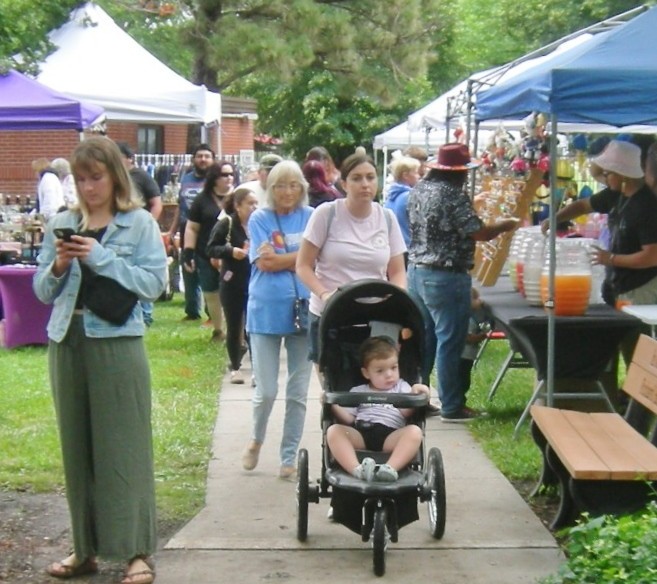
Forty people from across the state toured Garden City on Thursday as part of the Leadership Kansas program.
Each year, Leadership Kansas brings leaders together to tour eight communities across the state to broaden understanding of Kansas and expose participants to issues and opportunities facing the state.
The group took a bus tour around the community learning more about its success in retail, business and industry such as Schulman Crossing, DFA and empirical to name just a few.
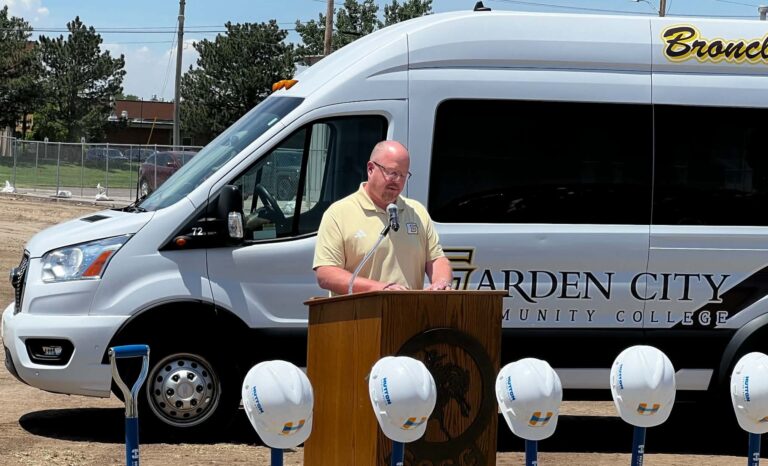
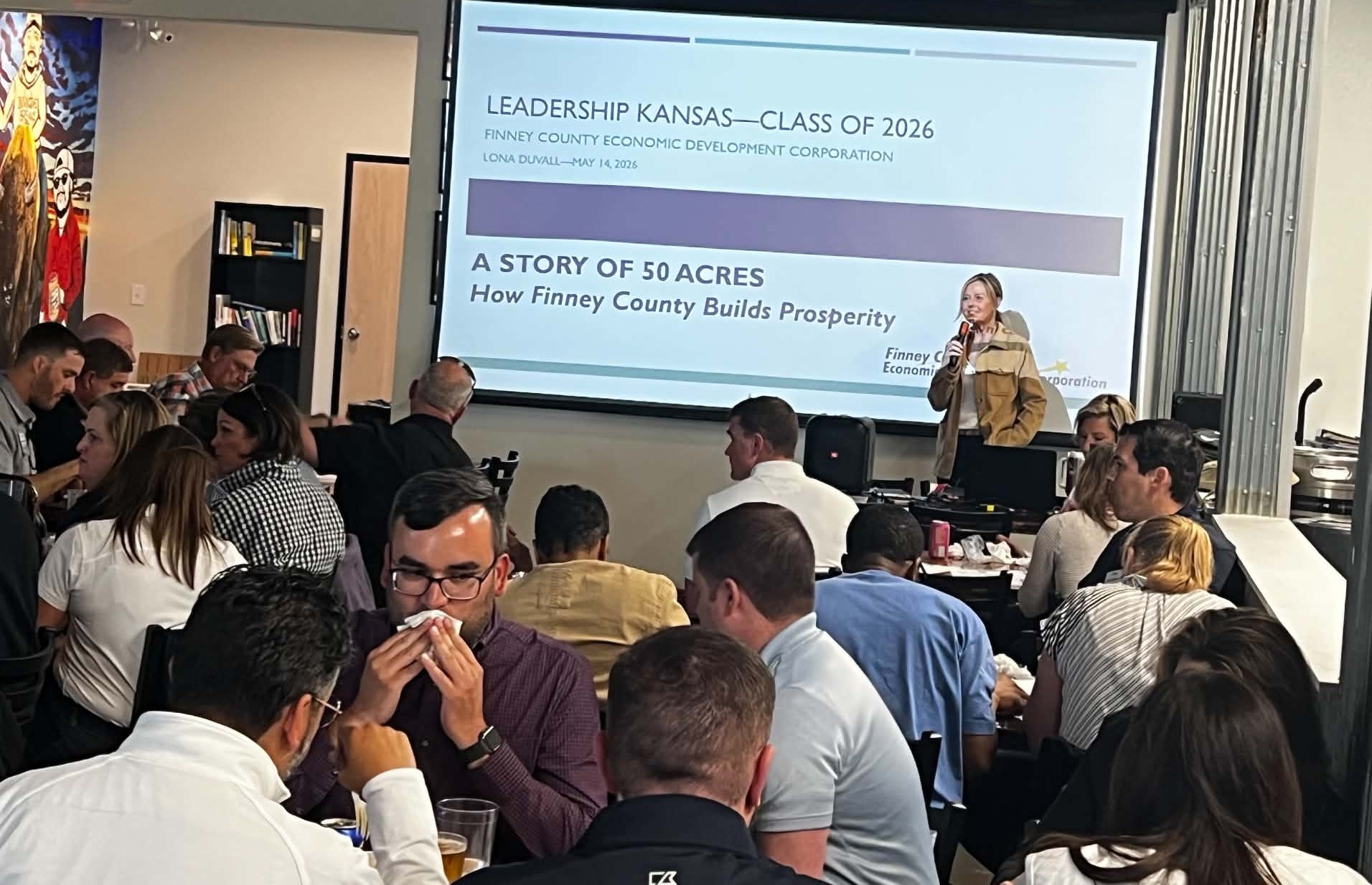
During a lunch break at Hidden Trail, the group learned more about Garden City’s growth over the past 15 years from Lona DuVall, President & CEO of Finney County Economic Development.
According to the USDA, Finney County has 821,000 farmable acres which is 98.5% of the land in the county. DuVall’s presentation focused on the increase in value over the past 15 years of 55 acres of land on the city’s southeastern side.
DuVall said that one piece of land started out as agricultural land, used a KDOT grant to turn it into a logistics staging area for TP&L in 2012, added an investment to build 8,400 feet of rail and then was sold in 2019 to empirical which built an advanced $500 million advanced manufacturing plant that employes more than 300 people.
The growth in the tax base is astounding. DuVall pointed out the rise in property taxes paid as the property use changed. In 2011, TP&L paid $4,474 in property taxes. By 2016, with the enhanced rail added to the property, they paid $30,398 in taxes. Then in 2025 when empirical was 90% complete, that company paid $2,183,768 in taxes.
DuVall compared current tax revenue of a nearby 168 acres of agriculture land that looks similar to the original 55 acres discussed previously. In 2025, that 168 acres paid $80 in property tax, or roughly .48 cents per acre. That’s a big difference compared to the 55 acres of land which now pays $39,291 in annual property taxes.
“There’s a little bit of a difference depending on how we choose to use our land, right?” DuVall said.
The bottom line is agriculture alone cannot provide enough tax revenue to support a community’s needs for schools, infrastructure, or public safety. An industrial and commercial tax base is required.
DuVall said property tax collected from agricultural land by itself is not even enough to fund the County road and bridge budget.
“Obviously, communities have to look somewhere else for what’s going to grow their communities,” she said.
It’s not just a Finney County issue. DuVall said between 85% and 89% of the rest of Kansas is classified as farmable, and another 2% of land in Kansas is publicly owned and pays no taxes
“We cannot have legitimate conversations around property tax control, changes, modifications, whatever they want to call it without acknowledging we have a huge amount of low tax value property in the state of Kansas,” DuVall said.
Finney County’s approach is to build on agriculture, convert selected acres into the highest value possible while still respecting and protecting the agricultural base. That approach resulted in growth of Finney County’s real property valuation from $246.6 million in 2011 to $534.7 million in 2025, an increase of 116% over that period.
“We drove that through a lot of infrastructure planning, rail enhancements, food processing, manufacturing, and those strategic plan decisions,” DuVall said.
DuVall also highlighted the impact of public-private partnerships. She noted that from 2010 to 2025, the community leveraged $165 million in public dollars which was then used to secure $1.2 billion in private investment in various projects. For every $1 of public investment, another $7 was secured in private dollars.
DuVall said the leadership group has likely heard a lot about industrial energy systems such as data centers, solar, and wind projects, battery storage systems, natural gas and nuclear. DuVall said it’s possible these project types could allow Finney County to capture significant water conservation, increased electrical capacity, thousands of jobs, and millions of dollars in additional tax base.
Finally, DuVall praised those who are participating in the Leadership Kansas program. DuVall, who went through the program herself a few years ago, said it’s a big time commitment but well worth it in the end.
“From our standpoint, locally, we’re talking about what problem are we trying to solve, what does the data tell us, what will actually improve lives, and what will help to prepare our community for the future,” she said. “I think we’re going to look back on this era we’re entering right now as the most transformative of our lifetimes, possibly the most transformative so far in human history. We are embarking on an era that is going to radically transform our lives.”
DuVall urged state leaders to not fear the future, but plan for it. She stressed the importance of keeping an open mind about the potential of the digital infrastructure age and the industrial energy systems that will be needed to power it.
“I hope you all will take an open mind to the conversations when they happen in your communities because they will happen,” she said.