



By SCOTT AUST / Greater Garden City
Artificial Intelligence and the growing needs of digital infrastructure are driving change across the country in how companies operate and people work and every major employer in Finney County will be affected.
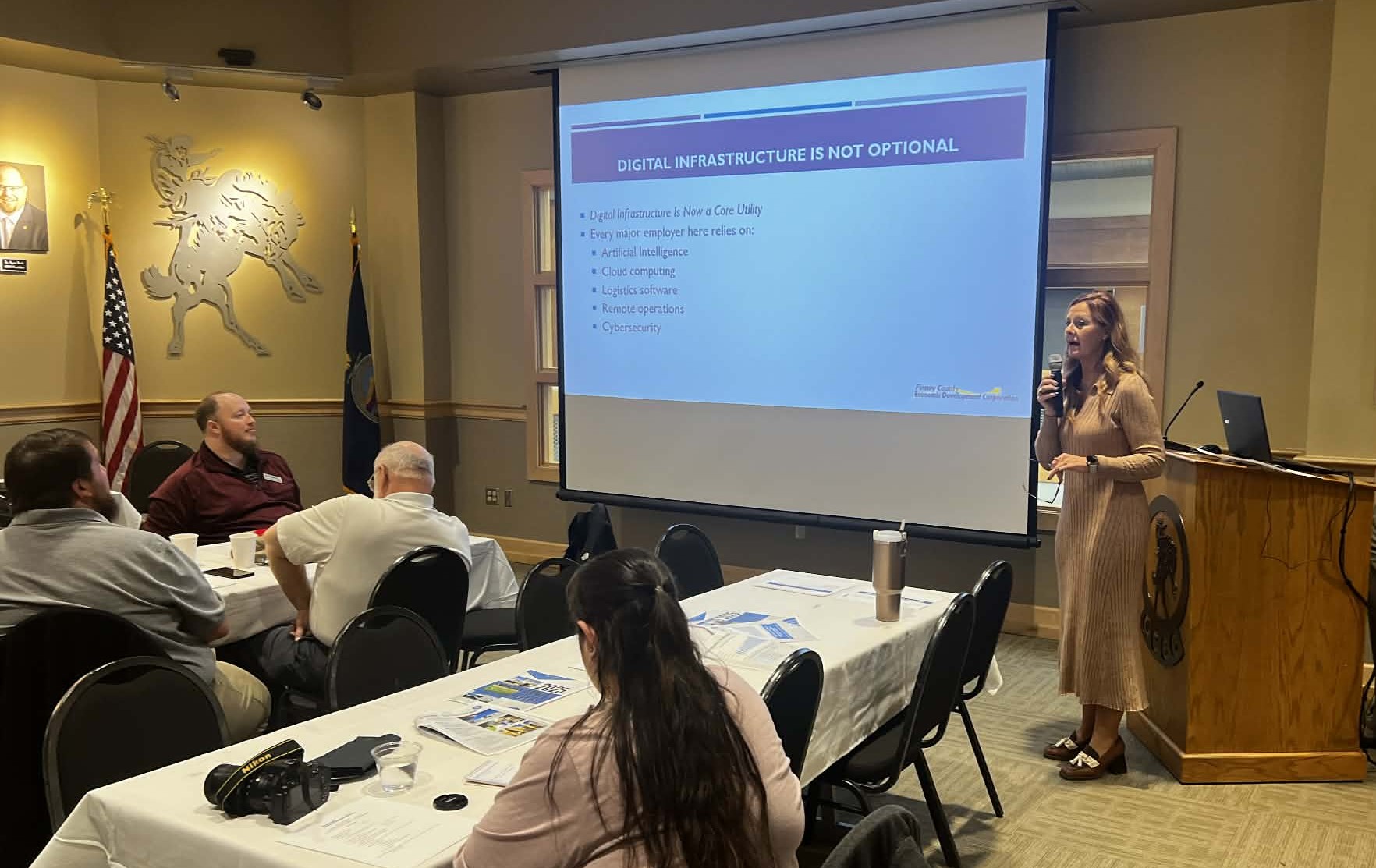
“The question is not if change is coming, it’s whether we’re going to lead that change or chase it,” Lona DuVall, President and CEO of Finney County Economic Development said during last week’s FCEDC annual meeting. “We believe this isn’t about chasing trends. It’s about adapting now to ensure that Finney County is still strong, prosperous and competitive 20, 30, 40 years from now.”
During a presentation about the Community of the Future and the local outlook for 2026, DuVall said the good news is Finney County already has the foundation for the future in that it has existing large scale industry; energy infrastructure; a skilled industrial workforce; rail, highway and logistics; available land; and a history of public-private collaboration.
“We think regionally and systematically. We function as one economic engine,” she said.
DuVall emphasized that a Community of the Future gets to design its own destiny. Those communities that are energy secure, data secure, workforce ready, food secure, and financially sustainable for local government will be better positioned to support AI-powered industries, advanced manufacturing, digital infrastructure, electrified transportation and modern healthcare and education.
DuVall noted how fast things changed in just a year: a year ago, AI was mostly talked about as software. But today it is driving the largest power and infrastructure investments in modern history and communities are either preparing for it now or getting left behind.
“This is no longer optional for communities,” DuVall said. “When we talk about digital infrastructure now, it’s a core utility. It doesn’t matter what type of business we’re working with in our community, we have to understand that digital infrastructure is going to be necessary for all of them.”
The computing power involved in digital infrastructure is real, physical infrastructure. AI doesn’t live in the cloud, she said, it lives in Digital Infrastructure Campuses which are large facilities filled with specialized computers.
Similar to factories, these data center campuses process information instead of making products. Data centers are becoming one of the largest new users of electricity and in many places, they drive most of the growth in power demand.
AI is no longer just a tech issue. It is now a land use, energy, water, workforce and tax base issue, DuVall said.
Digital Infrastructure
Every major employer here relies on AI, cloud computing, logistics software, remote operations and cybersecurity. Digital Infrastructure Campuses are no longer “tech industry projects” or simple “data centers.” They are regional infrastructure, just like rail, highways and utilities.
Digital Infrastructure Campuses can bring massive capital investment, very high property tax value; deliver stable, long-term revenue; and drive demand for power and workforce. Communities will be defined by how they collaborate to create responsible development – ensuring benefit and mitigating risk.
DuVall said investment decisions are being made now. The companies are looking for clear zoning, reliable energy pathways, cooperative local governments and a trained or trainable workforce.
“Communities that can deliver power, land and certainty are in a position to lead,” she said.
Once those decisions are made, the investment opportunity doesn’t circle back. Late moving communities will miss the window.
DuVall said all communities will be impacted. Communities that act now will capture large, stable tax base growth; attract high wage long term jobs; support existing industries that will also need AI infrastructure; and will be in position to shape projects to fit local priorities such as energy mix, water use, and design standards.
Communities that wait will face grid constraints without the benefits; lose projects to better prepared regions; and will end up “reacting instead of negotiating.”
Energy
Energy demand estimates have jumped fast. Just a year ago, DuVall said, power planners expected steady, manageable growth. Now, those forecasts continue to increase and are six times higher than a year ago. Data centers account for about half of all new electricity demand in the near term. Some regions are scrambling because they didn’t plan early enough.
Every industry will need to negotiate for their energy needs. Manufacturers, food processors, financial services, digital infrastructure campuses, healthcare systems, transportation networks will all need guaranteed, on-demand power.
“When we talk about needing this energy, it’s really important to recognize we don’t just need the energy for a kid making a TikTok video. We also need the energy for all the things that already exist in our community and all the things that we may want to exist in our community someday,” DuVall said.
DuVall quoted a 2025 International Energy Agency report that described how data center demand will drive electricity use and shape energy systems worldwide. That report said there is no AI without energy – specifically electricity.
Electric energy needs will be met from conventional power generators; wind; solar; battery storage; natural gas; and hybrid systems. DuVall said Finney County’s ability to support scalable Industrial Energy Systems gives us a competitive edge.
Industrial Energy Systems allow our existing industries to grow and sustain themselves, private companies to secure power, utilities to manage risk and communities to attract capital intensive industries.
Industries with large power needs can’t wait years for the perfect power solutions. As a result, their top priorities are having power that is available now, reliable and can scale quickly as demand grows. Most major users currently care less about how electricity is generated, they care more about whether it is available when needed, DuVall said.
By 2030 natural gas and coal are expected to supply over 40% of the additional electricity needed to serve growing demand, including from data centers, followed by renewable sources (wind and solar). Nuclear power, including potential new Small Modular Reactors, currently plays a small but growing role particularly after 2030.
Over time, by 2035, renewables and nuclear power are projected to account for more than half of the data center electricity supply mix in some model scenarios, reducing reliance on new fossil fuel generation.
Higher demand may keep existing coal plants running longer and could trigger reinvestment. Demand will also strengthen the existing natural gas sector and translate into new natural gas investment.
Energy Infrastructure
In a follow up interview after the meeting, DuVall elaborated that there are signs the federal government is growing more concerned about the national security and economic implications of delays in meeting the energy requirements for these projects.
The Trump Administration signed executive orders in 2025 related to reducing regulatory requirements on new nuclear projects. So far, they’ve reduced the more than 500 pages of regulations down to only 23 pages just in the past several months.
The Administration has also mandated that the permitting timeline for nuclear projects be greatly reduced. They have committed to shortening nuclear project permitting to 18 months – a process that historically has taken 10 years from concept to construction.
Additionally, they are increasing federal pressure to get large scale electrical transmission improvements underway.
“Communities that act now will have more input into what types of projects are constructed and reap the benefits of the increased tax base and employment opportunities that arise from energy projects,” she said.
Digital Infrastructure
DuVall said it’s important to note that the federal government is also signaling that it could begin to site digital infrastructure projects at the federal government’s discretion if they perceive that local efforts aren’t rising to meet the increasing demand.
The current administration has issued executive direction to accelerate federal permitting of digital infrastructure and data centers, explicitly linking Artificial Intelligence infrastructure to national competitiveness and national security.
Communities that position themselves as reliable partners for these projects stand to be rewarded for those efforts.
“While we understand the federal government’s focus on meeting these demands, we judge the government closest to the people should be at the table to ensure a federal ‘one size fits all’ approach doesn’t usurp our local control,” DuVall said.
A Little History
To illustrate a technology that drove change in the past, DuVall pointed to railroads.
In the 19th century, as railroads expanded west they created towns wherever depots were located. In essence, they were the Kingmakers of the time and towns that didn’t secure those depots faded away, they didn’t survive.
Some communities, like Garden City, had vision and were proactive.
Garden City’s founders, the Fulton Brothers, hired a promoter in 1879 to help persuade the Atchison, Topeka & Santa Fe to install a switch station/rail stop at Garden City.
“We didn’t passively wait to receive infrastructure. We competed for it and shaped the decision. That rail stop became the catalyst for settlement and growth,” DuVall said.
The name of that promoter? Buffalo Jones.
DuVall asked if anyone remembers the name of the guy who stood up and said he didn’t like the idea of those steel rails breaking up the farmland? Who remembers the name of the guy who said the railroad wasn’t even going to catch on and we’d be better served to invest in more wagon trails?
“The fact is history most often tells the story of the winners and not the whiners,” she said.
What This Means for Community Leaders
Governments at every level are about to face big disruptions, DuVall said, and must adapt to accommodate the future. Governments will need to explore new tax models, pilot workforce training and retraining programs, redesign service delivery, experiment with zoning and housing to meet population growth, and invest in placemaking to ensure community appeal.
“I think what’s important, what I really want you to take away from this, is those are monumental decisions leaders are forced to make. They’re often asked to make them quickly,” she said. “Sometimes we just have to act because the economy is moving faster than we’re prepared to adapt to it.”
Finney County has long had tremendous collaboration among its local governments, schools, college, and business and industry leaders.
“The relationships are incredible in this community. It’s gotten us where we are,” DuVall said. “We’re positioned to lead. We’re big enough to matter, small enough to move, diverse enough to serve as a representative community and united enough to coordinate.”
In response to a question about why some people would be opposed to data centers, DuVall said she sees it as a combination of lacking all the information necessary, outdated information and even in some instances active disinformation.
“We as a community are responsible for creating responsible growth. I feel confident with our local leadership that we will be able to responsibly welcome those projects,” she said. “But education is important. We intend to make sure to provide all the information needed to make smart decisions.”
Water Questions
Mayor Tom Nguyen asked about water regarding data centers.
DuVall said there are huge opportunities to work with companies on conservation. She said last year the Kansas Legislature passed SB 98 which included incentives – a sales tax exemption – to attract data centers.
Part of qualifying for that incentive includes not impacting water. Essentially, a project might be air cooled or use partial water cooling as long as other means are used to conserve water and not deplete the resource.
Agricultural demand accounts for the largest use of water in our area. In 2024, more than 75 billion gallons of water was pumped from diversion points within Finney County. Reallocating just a portion of that water toward building a modern Digital Infrastructure Campus (DIC) and Industrial Energy System (IES) would result in net water savings overall.
As an example, a hypothetical DIC and IES with roughly the same electric demand and supply of Sunflower Electric (350 MW), sited on land used for agricultural production and accounting for 1.25 billion gallons of water use annually, would require only 250 million gallons of water per year, assuming it was a modern, closed-loop water cooled system. Construction of this project would result in a net reduction of more than a billion gallons of water per year. With an air-cooled facility, the water savings would be even greater.
DuVall said the local community is positioned so it can make additional demands regarding a project and it provides an opportunity to work with those industries on water to benefit both parties.
Finney County Commissioner Kevin Bascue said the elected officials and community partners in the room can make decisions on what Finney County and Garden City will look like in 50 years.
“We just have to have the nerve to act on what’s right to ensure that we continue to be a vital place to live and work and everything else in the future. We have that opportunity to be Buffalo Jones,” he said.